
222 – TMG Hospitality Trailblazers: Shozib Khan
by Cassady Quintana | November 19, 2026
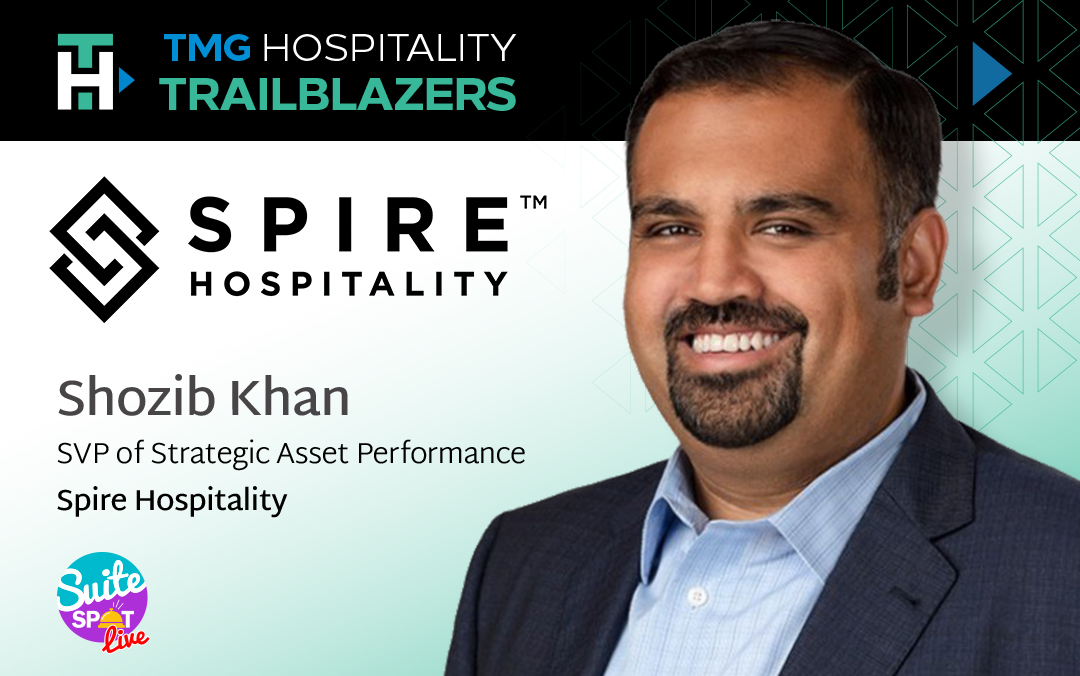
Welcome back to another edition of Suite Spot’s TMG Hospitality Trailblazers Series, all about the people in hospitality who are driving and paving a path forward in the rapidly evolving industry! Today, we welcome SVP of Strategic Asset Performance at Spire Hospitality, Shozib Khan, to discuss technological advancements, the importance of human interaction in hospitality, and so much more! Tuning in, you’ll hear all about our guest’s background in the hospitality industry, what his new role at Spire Hospitality entails, and what he learned about the health of the industry from a conference he recently attended. We delve into why Spire Hospitality created its Strategic Asset Performance Division before discussing how Shozib is handling the challenge of leveraging AI to make the lives and roles of the team members supporting his business better, and what he thinks is driving AI and technology into the industry. He even touches on how Spire is ensuring that its properties are noticed by LLMs, how they implement new technology, and how they’re executing technological changes. Finally, our guest shares his predictions for the future of hospitality and his hopes for Spire Hospitality’s future. Thanks for listening!
Ryan Embree: Hello, everyone. Welcome to another episode of the Suite Spot Podcast. This is your host, Ryan Embree, here for another edition of our TMG Hospitality Trailblazers series. This is your first 15th. This series is all about the people and the organizations within hospitality that are driving and paving a path forward, which is ever-evolving and changing at a much rapid pace than we’ve ever seen before. And I’ve got a great guest with me today, Shozib Khan, SVP of Strategic Asset Performance at Spire Hospitality. Shozib, thank you so much for taking the time with me today.
Shozib Khan: Ryan, thank you so much for hosting me. Looking forward to our conversation. And thank you to Travel Media Group as well.
Ryan Embree: Yeah, absolutely. We’re excited to have you on. Before we get rolling into this, hospitality is just a big blender of backgrounds, sometimes from different brands, sometimes from different states and areas of the country, or even sometimes the world. That’s what we love about our transferable hospitality skills. Before we get into today’s conversation, give us a little bit of background, Shozib, on your hospitality journey and what led you to Spire Hospitality.
Shozib Khan: Absolutely, Ryan. For me, it’s a very easy story. I was going to school and there was a hotel right next to the college that I was going to. And that was in 2000. So I can do math very easily on how long I’ve been in this industry. It’s been a little bit over 26 years. And my first role was really supporting my education in chemistry by working at the front desk. And never in my wildest dreams did I ever think that hospitality was going to be my career. But from the very first day, it became addicting on how hospitality works and not just what hospitality is, but all the different facets of hospitality. I was introduced to technology right off the bat. I was introduced to concepts of revenue management, accounting, and marketing. And everything just came together. And 25 years later, here I am.
Ryan Embree: Here you are. Yeah. I love the story. We hear it a lot in leadership and hospitality. And you’re absolutely right, I think there needs to be a paradigm shift on what the outside looks at hospitality and what they think a hospitality job is, because there are so many different facets of our industry. I mean, we just got back from the hospitality show, which talks about every single one of those facets. It’s one of the most complex industries, which people love about it. And it’s hard to be an expert at all. But I just love that story because we hear it so much. And I hope that that is starting to change a little bit is the perception of what a career in hospitality looks like, because it doesn’t just mean that you’re staying behind a front desk all the time.
Shozib Khan: You know, I met our current CEO about 13 years ago. And at that point, he was a GM, and he said something to me, which has stuck with me. We talk about the American dream, and we talk about what that actually is or what that looks like. But you mentioned that hospitality is one of those last frontiers where your grit, your resilience, your effort can take your career to wherever you want it to go. At that point, 13 years ago, he was a GM of a full-service hotel in Marriott Burbank. Today, he’s the CEO of Spire Hospitality.
Ryan Embree: It’s a great point. It’s a great point. Great story. And we need to showcase more of those stories out there because there’s so many of them. And speaking of, you recently took on a new role at Spire Hospitality. Congratulations, first off. Talk to us a little bit about this new role and what you hope to achieve in it.
Shozib Khan: Thank you. I was promoted to SVP Strategic Asset Performance in September. And really, it was not just a role for myself. It was a strategy that our new CEO and I partnered on on how do we find a way to connect the dots of what happens in a management company that’s outside of sales and marketing, commercial, and outside of operations? And when we start really dissecting everything else that happens behind the scenes, of course, you have your accounting function.
But next to the accounting function, you have silos, and technology, and analytics, and risk management in data analysis and reporting. And the vision of putting together the strategic asset performance division was finding all those functions that are connected and aligning them behind a single strategy that helps our hotel owners. It also helps our hotel general managers. It has to be a solution that wins for both operators and owners and bring IT, financial planning, hotel systems, hotel resources and transitions, brands powered by AI is where we thought the next frontier is, and that’s what we have executed on.
Ryan Embree: It’s funny you bring that up because I think that has been kind of the promise over the last couple of years of talking through, having these conversations through technology and AI is breaking down those silos, breaking down those barriers. For you and your team to have the foresight to go in there and say, “Hey, we’re going to attack this. We see this as a problem, but we also see on the horizon that there’s a solution here.” I think that’s super compelling. And I’m sure your owners, investors are loving to hear that in your new role and excited to kind of see what we’re going to talk a little bit later about some of maybe those first projects that you want to get done in that new role.
But you’re fresh off a lodging conference you had just a few weeks back. I always like to get the take because I think those are great temperature checks, those events at different times of the year, those hospitality events. What was the overall sentiment that you are hearing from those owners, developers, and brands there around the health of the industry right now?
Shozib Khan: My takeaway was the sentiment continues to be cautiously optimistic. We want to continue to stay excited about our industry, but we can’t have blinders on to the real headwinds along with the geopolitical uncertainty and rising costs that continue to impact our margins.
Margin erosion is very real. We know the owners are certainly feeling it, and they’re well aware of it. We know the brands are also aware of it. And as us operators, we have to acknowledge the fact that margin erosion is real, but we also have to find solutions that bring margin back to our hotels. And we can’t just do that by cutting costs. It means being strategic on how we deploy new, ever-evolving technology that’s available to us that makes everyone’s lives easier, not just our operators, but also our team members that are within the property itself.
Ryan Embree: Yeah, I get that sense, too, of that cautious optimism. And the optimism just comes from the resilience of our industry. I mean, we keep taking punches, and we keep growing, which is great. Our travelers are still dipping into their pockets and prioritizing travel. But is that leash kind of running out there? And I think that’s where the cautious side of that cautious optimism comes from, and seeing the headwinds and challenges above kind of in front of us.
But again, we’ve been a resilient industry over the past couple of years because we’ve heard that story of all those challenges and headwinds, and we keep taking those punches. So it’ll be interesting to see what if any of those topics or issues that were raised and top of mind at the lodging conference. And are you seeing any of those conversations that you had there kind of reflected in Spire Hospitality’s portfolio?
Shozib Khan: Absolutely. Part of the reason why Spire deployed the Strategic Asset Performance Division was really a direct response to the environment that we’re in right now, where margins are under pressure, and we need to find ways to find hidden opportunities faster in response to the needs of our owners.
And one recurring theme that came up at lodging over and over again was AI. A couple of years ago, AI was around, and it was an interesting subject. People were talking about it, but they really didn’t understand how it was going to change lives. Now it’s changing lives, but we don’t understand how it’s actually going to all fan out when the dust has settled. It’s a game changer, and we know this. Anyone that’s utilizing it in any capacity is curious about it, is nervous about it. And they also want a strategic plan on what it does.
And for Spire, our AI strategy is twofold. Nancy Johns, SVP of commercial strategy, was also brought onto our team several months back. And her focus is to find the commercial opportunity. Commercial opportunity, we see that there is significant upside on that. My lens is to find operational opportunity. One thing that may not sound as exciting, but one of the biggest expense line items that is on our P&Ls is insurance. The cost of insurance goes up year after year after year.
How many strategies are actually being deployed or being created on where we can leverage tools that are developed or created or supported with AI to hedge against our potential exposure on the expense line? Another way to say that is how can we make incident reports smarter? Because we do know people are going to slip and fall on water parks.
Ryan Embree: Right. Yeah. I don’t think AI is going to change that one anytime soon. There are those risks there. But you’re absolutely right. I think one of the things that our industry has been really, really great at is when we have that challenge and that problem, we get really, really creative with how to fix and solve it, right? And these margins have been tight now for several, several years. And it just feels like the smart leaders out there are looking at every single corner to try to figure out not how to cut expenses like you’re talking about, but become more efficient. And the tool and vehicle that could potentially get a lot of the industry there is through kind of AI and tech.
And I heard you say, Shozib, in a recent interview that your challenge right now is how your team can use AI to make the lives and roles of the team members supporting your business better. So I want to ask you, what does that better mean to you? And how are you approaching kind of that challenge?
Shozib Khan: Yeah, for us, better means removing friction, not removing people. AI should handle the repetitive, manual, boring stuff, which is also extremely important. So team members can spend more time on judgment or guest interaction or creative problem-solving.
One of the items that is really, really hard to measure on a P&L is the leadership on site. And we know this, that leadership and strong leadership teams on our assets generate stronger results on our P&L statements. And one item that ends up being a barrier to being a good leader is where time is focused on. And if our GMs or our leaders are behind the screen, they’re not in front of their guests, they’re not in front of their team members, and they’re not able to do what they are really, really good at, which is finding ways to inspire and create and finding ways to really optimize how the team works together at the property to deliver results. And if we can create tools that gets them away from their screens and automate things that move things faster, we’ve already won.
Ryan Embree: Which, by the way, that was the true intention when the GM position or the AGM or the front desk manager. When that position and that role was created back in the day, that was the true intention of that. And I think it’s probably – you’ve seen it since – I think 2000 would be a great time to probably look all of that minutia that kind of got put on a GM’s plate in hospitality, where they, all of a sudden, started spending more and more time on the wrong side of the front desk, right? Where they couldn’t be, like you said, leaders.
It’s my hope – when I have all these conversations about AI and tech on this podcast, but it’s my hope that hopefully the GM of tomorrow looks a lot like the GM of the past and not so much that one that was sitting there trying to figure out what do my room rates look like on the 30, 60, 90 and looking at star forecasts and all that stuff that is now kind of fallen on top of some of these industry professionals. It’s very interesting. We’re at a very interesting inflection point right now in our industry.
Shozib Khan: And we have now tools and technology where we can, as a management company that has roughly 30 hotels in our portfolio, where we can develop software or develop applications or develop tools that directly impact how we can improve the lives of the GM.
One of my mentors, John Marco, from when I first started in the industry, he used to say that he has an MBA in hospitality. And that’s great. And then I didn’t realize at that time that that MBA was a punchline to an internal joke, which was so true. He goes, “Do you know what an MBA in hospitality means?” “No, I really don’t. But it sounds like you got your master’s degree.” He was like, “No, no, no.” He goes, “I managed by walking around.”
And when you go back to what we were doing in 2000s, before we were behind our screens almost six to eight hours of the day, our really, really successful leaders were really walking around, and they were connecting with our guests, and they were on the marvel, and they were connecting with team members, and they were setting the tone of what hospitality needs to look like by human interaction, not by paper or digital interaction. With the initiatives that Strategic Asset Performance is working on deploying, that is the end goal that we’re working towards.
Ryan Embree: That’s great. I love to hear that because, again, I think there’s a lot of worry. We have another series called the TMG Hospitality Campus Crawl, where we’ll talk to deans of hospitality schools across the country. And a lot of them are mentoring this next generation of hotelier, and they’re nervous. They’re hearing these things about, “Is there going to be a job for me on the other side of this?”
And to hear you say that you want to get back to what hospitality, the core of that is, it’s refreshing to hear. And I think it’s hopeful for that next generation of hoteliers that they’re going to be able to do. Because I think you said it best with your story, Shozib, the top of this, you fell in love with the industry. I’m sure it wasn’t because you were looking at all those reports saying, “Oh, I want to stay in this industry for another two decades because I just love looking at this computer screen.” It was interacting with those travelers and seeing real experiences happen in real time and being able to have an impact on those. That’s what hospitality is. And that’s where hopefully we’re getting back to.
Shozib Khan: The fun part about this industry is the fact that on-site, at a hotel, there are no two minutes that are ever alike. There are no two days that are ever alike. There’s no two situations that are ever alike. And there are plenty of problems to solve. You mentioned on what I fell in love with. I fell in love with the fact that there were so many problems to solve, and you did need reports, and you also needed the ability to connect with each other and support each other. It was not an individual contributor job at all. It never has been.
Hospitality is that rare industry where you have to be able to support your fellow team member, whether you’re a server or you’re in the kitchen or you’re at the front desk. What you’re doing is going to have an impact on other people on site. And if we can take away some of those barriers that take and create friction that makes their lives harder, that really is what the game is all about.
Ryan Embree: That’s the dream. Yeah, it’s the ultimate team sport there. I’m curious, we’re having this conversation, and I’m thinking, I think one of the reasons hospitality has responded so quickly to AI and tech faster than maybe in the past is because the traveler’s getting there a lot quicker. And they’re starting to use it for things like search inspiration.
And I’m wondering, with the conversations, what do you think is driving that AI and technology into our industry? What’s driving it more? Do you think it’s from the traveler side and the hospitality industry is just like, “We have to react?” Or do you think it’s from the ownership side that is seeing this promise of, “Okay, AI tech, I know it’s out there. What are you guys doing, right? How are you guys making my business more efficient and saving me money or making me more money?” Where do you think that balance is?
Shozib Khan: There are two sides to that. The first side is the commercial side. We know from a consumer standpoint that AI-driven traffic to U.S. travel sites increase by roughly 119% year over year. We know that 43% of our travelers now use AI tools for research and inspiration. And I can tell you that I took my girls to a trip earlier this year, and I’ve never done that before, but I planned the whole trip in five hours by just doing a couple of prompts. And everyone’s doing it.
Personally, I believe the reason for that is consumers have so much noise and they don’t know what source to trust and they want to get answers fast. And so from one angle, using AI and leveraging AI has found them a single source of truth that can give them the answers they’re looking for. Now, single source of truth is subjective. And on our own internal audits, we know that some results that have come across from AI-driven searches for a particular area, or even a particular asset have brought in information that may not be true.
And so as an operator, our goal is to make sure that when that information is queried by whatever large angle model that someone’s utilizing, that the data is as accurate, up-to-date, current as possible so that we don’t break a promise before we have even started a relationship with a consumer that’s visiting our hotels. That’s part of the broader strategy that Nancy and the commercial team is doing, which brings marketing, search engine optimization, but really turns into large language model optimization and puts it all through.
On the owner’s side, we know that there are going to be some low-hanging fruit that we can move really, really quickly on. One of them is going to be on finance and accounting items. There’s repetitive work that’s there that can be automated. And we’ve been automating some of those items for the past five, six years. But with the deployment of AI and how rapidly it’s evolving, ideas can move from a scratch piece of paper note to something that we can activate and deploy within a day.
Ryan Embree: Yeah, it’s the dream.
Shozib Khan: And that’s where we believe that it’s a double-sided effort, one on the commercial side and the other one on optimization and all the tools that are keen to utilize.
Ryan Embree: Yeah. You mentioned in there about the AI search and visibility, and I think that’s what’s really been sparking a lot of this right now, certainly driving a lot of the conversations we’re seeing at these events. And you mentioned some of the misinformation. I think it’s honestly going to be like a trust economy here of trying to get – you want to get a lot of information, but you also want to make sure it’s the right information that’s put out there. So what’s the strategy with making sure that the Spire Hospitality properties are getting noticed by travelers using LLMs for that research and inspiration?
Shozib Khan: Yeah, on the strategy side, we’re ensuring that our data structure that’s available, our property descriptions are rich in content, and we don’t have any stale information across anywhere. It’s really ensuring that we’re reviewing any profile that’s out there that talks about our hotels. And we’re auditing, reviewing, and ensuring that there is a single source of truth that all of them are benchmarked against.
Where AI gets confused is when AI has two different competing sources of truth. And our goal is to ensure that anywhere that there’s visibility, we have audited, reviewed, cited, updated, and corrected so that, at the very least, we’ve got everything on our side to empower AI to generate the best response that it can.
Ryan Embree: Yeah. And one of those spaces in hospitality, just because of the nature of our industry, that you might see those direct kind of conflicting pieces of information could be guest feedback and reviews. Right? You could have one review saying this property is super clean. We loved it. And the other one right next to it saying property was dirty and not taken care of. So trying to control those as well. I mean, obviously, there’s no way to effectively managing your reputation. Social media strategy also really, really critical during this time right now because it’s going to play into those results.
Shozib Khan: It is. And consistency of execution becomes even more important.
Ryan Embree: Yes.
Shozib Khan: If you have a review that’s coming in every other day that’s giving an alternative view from the guest, you’re not going to win. And that’s why getting back to the fundamentals is key, where it doesn’t even start without us having operations where they’re efficient and well-run to begin with. We have to take care of step one before we can move towards step two.
Ryan Embree: Yeah, it’s all cyclical. It comes back to just taking care of the guests. And, again, hospitality at its core. There’s no cheat codes there or shortcuts when it comes to that. Now, Spire Hospitality has an incredible and really eclectic portfolio. We were talking about your almost thousand-room water park resort right here in our backyard, Orlando. And a couple more select-service properties, a little bit smaller.
When you look across your portfolio, and you’re thinking about implementing a new piece of technology or AI, and you have that just wide spectrum of property, how do you gauge that? How do you work as a team to say, “This is going to be a good fit, or maybe we pursue over here and don’t over here?”
Shozib Khan: The fact that we have such a diverse portfolio within our organization gives us an advantage. We have full-service Marriott’s, we have Hilton’s, we have Lifestyle Independence. And having a tool that works for a 1,000-key condo hotel that at times can have close to 5,000 guests on site may not fit into the model of a 55-room lifestyle hotel in Birmingham, Alabama.
However, there are certain fundamentals, even without the scale side, that are going to be true. Every asset is going to need a P&L statement, whether it’s large or small. My internal joke is nothing happens until sales sells something because that is really the first thing that needs to happen. But when I’m hanging out with my accounting friends, even if sales sells it, unless accounting can record it, it never happened. So someone has to make sure that it gets recorded.
And finding ways to streamline and automating some of our back-of-the-house accounting functions is universal. That is going to help every single hotel, whether it is small or large, because P&L still has to be published. Another area of opportunity is labor management. We know that labor ends up being our number one expense driver. And it’s not necessarily managing labor by sitting behind a desk. It is providing leadership training and simplified reports where you can not only engage the general manager, but you can engage department heads that are responsible for putting out the most expensive purchase order, which is that schedule, so they understand what labor management is and what the objectives are.
And with the tools that we’re working on and some that we’ve already deployed, using the data that’s already available to us, we’re testing out potential solutions that work universally across. At our independent hotels, we know that we have a little bit more of an opportunity to get really granular with our data that’s available in our PMS systems and optimize. At our branded hotels, we are waiting and also connecting with our brand relationships to see all the fun tools that they’re working on behind the scenes. But regardless of the fact, there are some universal cores that we provide as operators that are going to help every asset in our portfolio.
Ryan Embree: It really is truly a time of – and I know this is going to sound dramatic, but intense innovation and change in our industry. I mean, I don’t know if there’s ever a single point in hospitality that we’ll be able to point to to say that there are the most test betas, programs that are being run, or even just what you said, created in real time. These things are all being played out right now, and we’re in this giant sandbox as an industry. And it’ll be very, very interesting kind of to see over the 6 to 18 months kind of what comes of that.
I’ve even talked to some hospitality leaders who said, “Hey, we tried these things, and it didn’t work. It just straight up failed, and we’ve got some great learning from it.” But it’s just a time of experimentation right now in our industry, which is really exciting, can be scary because that’s a lot of time, resource, and capital that can be spent right now. But I also think the dividends on the other side of this are going to be really great for those that are prioritizing it, like Spire and putting you in that position.
And Shozib, I’m sure when you got the role, there were some probably initial things, low-hanging fruit that you were talking about. But what are some of those areas that you’re prioritizing first, and maybe some of the shorter-term goals in the first 60 to 90 days?
Shozib Khan: This is the not-so-fun stuff. First, very, very excited. We have an amazing VP of technology who’s a hotelier first and then understands how PBX systems and POS systems and PMS systems work. We have the right tools, and we have the right resources that are on site. But when I say the right tools, we’ve been working on cleaning up our data and elevating our analytics platform for the past five, six years.
We went through a massive chart of account migration to ensure that our chart of accounts, our actual GLs and the GL descriptions are AI-ready. We can’t start innovating and can’t start deploying tools until we have a good solution for infrastructure. And that’s what Tom has been focused on, where Tom is building the infrastructure. So that once someone has an idea of what they want to do, there’s a central path that allows us to publish and allows us to activate.
Real world story: we’re in the middle of budget seasons and one of the items that gets scrutinized, reviewed, and optimized over and over again is market segmentation and market segmentation track. We had a team member that use the data that’s available to them and put together a very interesting report that shared some good insights on how we should look at market segmentation.
Shared this project with Tom and with a team. And in less than 24 hours, we had a portfolio wide solution that was published on an Internet that was accessible by our entire leadership team at the home office, as well as our leaders on site. And the speed to market on ideas is really related to how quickly we can execute. And we can’t execute without the infrastructure.
Over the past 60, 90 days, and even well before that, it’s ensuring that we have the right infrastructure in place so we can execute on all the things that we’re innovating on a go-forward basis.
Ryan Embree: I love to hear stories like that because I think we’ve had countless number of panels that we’ve listened to in our industry of saying, “Well, this is what it could do. This is what it could unlock. This is what it should do. This is the dream.” But more and more, I’m starting to hear those real-world scenarios and situations. And those are the things we need right now in our industry are the real-world applications to some of this stuff. Because you can get lost in it, right? You can get lost and say, “Well, long-term, this is what it’s going to look like.” But what are we doing now? And it’s exactly what you said. You have to have the infrastructure. You have to have the ground footing before you can – you do have to have some sort of kind of walk before, or crawl before you walk before you can run sort of situation.
What about further ahead as we kind of wrap up? We always like to wrap up our episodes kind of looking long term, which now is impossible to predict, right? It feels like we could be sitting here in six months and be completely wrong about some of our projections and predictions. But what about further ahead? What’s your vision for the future at SpireHospitality? And how does that vision fit into your new role?
Shozib Khan: Yeah, Spire’s vision under our new CEO, Richard Sandoval, centers on a data-driven decision-making that’s AI-enabled with innovation and finding ways to keep our partnerships with our owners. And that vision has to be executed, and that requires strategy and execution to balance together. And that’s where the Strategic Asset Performance Division really comes into place, where the operation engine behind that vision.
Spire’s expanding both with our parent company, AWH Partners, and also through third-party management relationships. But you’re 100% right. We don’t know what it’s going to look like a year from now, given how quickly AI is evolving. The part that we do know is that our leaders are still going to be on site and GMs are still going to be responsible for their assets. And the leadership that is at the management level as well as at the hotel operations level is going to be there for success.
So we are ensuring that our innovation that we’re putting together, it’s not just another tool, but it’s something that our GMs can actually execute on as well. And if it’s not something that’s hotel phasing, it’s ensuring that things that we’re deploying add value not just from a cool perspective or innovative perspective, but something that actually brings value back to our P&L statements, finds ways to drive NOI, or simply gives time back to our –
Ryan Embree: Yeah. Yeah, control what you can control in this time of a lot of change right now in hospitality. But it’s been a fun conversation. True embodiment. Like I said at the top of this, this is a TMG Hospitality Trailblazers series. A lot of things I’m hearing from you and the team over at Spire Hospitality seems to embody that spirit of trailblazing forward. So thank you for taking the time. We know you’re busy over there. And any final thoughts before we wrap up today?
Shozib Khan: Thank you, Ryan and the TMG team and Suite Spot for hosting me. We’ve discussed technology and we’ve talked about vision, but at the end of the day, none of this works without the right people, the right culture and values behind it. And one thing that I learned early on in my career is that people, hospitality, those two are never going to separate, no matter what type of technology or innovation we bring back.
And as long as we can stay true to our North Star, we can win as a team, we can win as a company, and we can also win by performing for our owners.
Ryan Embree: Love to hear it. Awesome. Well, we wish you nothing but success. Appreciate you taking the time again. Congratulations on the new role, and we’ll be sure to keep an eye and an ear out for all the exciting things happening at Spire Hospitality.
Shozib Khan: Thank you, Ryan.
Ryan Embree: Thanks, Shozib.
Hotel Marketing Resources
0 Comments